Strategic Sourcing Guide: Why Partner with Top China Storage Racking Manufacturers
Modern global logistics, rapid e-commerce expansion, and complex cold-chain networks require robust industrial storage architecture. Procurement managers, logistics engineers, and warehouse operations directors face a critical mandate: maximize vertical cube utilization, ensure absolute seismic safety, and reduce total cost of ownership (TCO) per pallet position. As the world's leading manufacturing hub for structural steel products, China offers unparalleled economies of scale, advanced roll-forming technology, and high-tensile metallurgical consistency for warehouse storage racking systems.
Selecting the right China storage racking supplier and wholesaler is a decision that extends far beyond initial price per ton. It requires comprehensive evaluation of structural engineering compliance (such as ANSI MH16.1, FEM 10.2.02, RMI, and AS4084-2023), steel grade traceability, automated cold-roll forming tolerances, and surface finish longevity under high-humidity or sub-zero operational conditions. Top-tier Chinese manufacturers operate state-of-the-art facilities equipped with continuous automated roll-forming lines, robotic welding stations, and automated electrostatic powder coating plants capable of producing high-density storage systems that seamlessly interface with automated guided vehicles (AGVs) and Autonomous Mobile Robots (AMRs).
Metallurgical Engineering, Seismic Design & Coating Integrity
In structural racking design, safety factors and material compliance are non-negotiable. Leading Chinese manufacturers prioritize structural integrity by utilizing premium-grade carbon steel, predominantly Q235B (yield strength $f_y \ge 235\text{ MPa}$) and high-strength Q355B steel (yield strength $f_y \ge 355\text{ MPa}$). Q355B offers superior load-bearing performance with lower deadweight, making it the preferred choice for high-bay racks exceeding 10 meters and automated storage and retrieval systems (AS/RS) where tight structural deflection limits ($L/200$ or tighter) must be maintained.
1. Seismic Design & Dynamic Load Calculations
Warehouses constructed in active seismic zones (such as the Pacific Ring of Fire, South America, and parts of Southeast Asia) require rigorous dynamic structural modeling. Advanced storage racking designs incorporate seismic baseplates, anchor bolt pattern optimization, and stiffened upright bracing frames designed in accordance with ANSI MH16.1, FEM 10.2.02, and AS4084-2023 standards. FEM dynamic simulations verify vertical shear forces, second-order P-Delta effects, and frame stability during lateral ground acceleration.
2. Cold Storage & Coastal Anti-Corrosion Finishes
Surface treatment dictates the operational lifespan of steel storage equipment. Warehouses located in coastal logistics parks (facing airborne salt humidity) or deep-freeze cold storage facilities (operating at $-25^\circ\text{C}$ to $-30^\circ\text{C}$) require specialized protective coatings:
- Electrostatic Epoxy-Polyester Powder Coating: Applied at 60–80 microns thickness following a multi-stage pre-treatment wash (degreasing, phosphating, and deionized water rinse). Provides excellent impact resistance and anti-scratch durability for ambient temperature logistics hubs.
- Pre-Galvanized & Hot-Dip Galvanizing (HDG): Hot-dip galvanization according to ISO 1461 deposits a zinc layer of 80–120 microns, providing complete sacrificial cathodic protection against rust in high-humidity or sub-zero condensation conditions. Perfect for shrimp, seafood, and agricultural cold stores.
Future Sourcing & Technology Trends in Industrial Storage Racking (2025–2030)
The industrial warehousing sector is undergoing a rapid transition toward automated, high-density, and carbon-neutral infrastructure. Overseas buyers sourcing racking systems from China should align their procurement strategies with four key industry transformations:
1. Seamless AGV / AMR and Four-Way Shuttle Integration
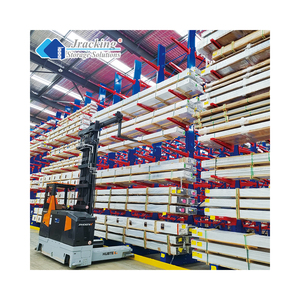
Traditional manual forklift racking is increasingly giving way to 4-Way Radio Shuttle systems and automated high-bay racking. Modern storage racks must meet ultra-tight geometric tolerances ($\pm 1.0\text{mm}$) across height extensions over 20 meters to accommodate sensor-guided automated shuttles and crane grippers without mechanical binding.
2. High-Bay Clad-Rack Warehouse Structures
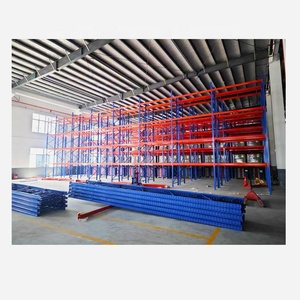
In clad-rack self-supporting buildings, the steel racking system serves dual roles: supporting the unit pallet loads and acting as the structural building frame for wall cladding and roof panels. This architecture eliminates the need for conventional building columns, reducing construction timelines by up to 25% and drastically improving footprint ROI.
3. Green Steel & Sustainable Powder Coatings
Scope 3 carbon emissions compliance is driving demand for environmentally friendly warehouse equipment. Top China manufacturers are adopting recycled electric arc furnace (EAF) steel billets, zero-VOC powder coatings, and solar-powered manufacturing lines, enabling global buyers to meet corporate ESG and environmental sustainability goals.