1. Enterprise Engineering Supremacy: Standards, Metallurgy, and Seismic Resilience
Navigating the complex global market for industrial warehouse infrastructure requires an unyielding focus on structural integrity, metallurgical provenance, and precise engineering compliance. As leading China pallet racking and shelving exporters, our manufacturing architecture is built around rigorous international codes including ANSI MH16.1 (Specification for the Design, Testing and Utilization of Industrial Steel Storage Racks), EN 15512 (European Standard for Adjustable Pallet Racking Systems), and FEM 10.2.02 (Racking Design Guidelines).
The fundamental foundation of structural storage safety relies heavily on raw material composition. We utilize prime-grade certified structural steel, primarily Q235B and Q355B cold-rolled steel profiles. Cold-formed profiles engineered from Q355B steel deliver an exceptional yield strength ($f_y \ge 355 \text{ MPa}$) and tensile strength ($f_u \ge 470 \text{ MPa}$), allowing optimized structural weight while drastically increasing vertical column load-bearing capabilities. For high-bay distribution centers operating VNA (Very Narrow Aisle) or AS/RS (Automated Storage & Retrieval Systems), maintaining tighter deflection tolerances ($\delta \le L/200$) is critical to prevent automated crane jamming and operational failures.
Information Gain Insight: Unlike standard local fabricators who perform basic static weight estimations, top-tier Chinese manufacturers execute 3D Finite Element Analysis (FEA) simulations. FEA models accurately predict elastic-plastic buckling, torsional frame distortion, baseplate stress concentrations, and seismic shear forces under complex multi-axial loading profiles.
Seismic Engineering for High-Risk Fault Zones
For logistics hubs situated along global seismic activity lines—such as the Pacific Ring of Fire across South America, Japan, and North America—standard upright profiles are structural vulnerabilities. Our specialized engineering division custom-calculates seismic response spectra adhering to NEC-SE-DS (Ecuador Construction Standard for Seismic Hazards), ASCE 7, and EN 16681.
Seismic-hardened configurations feature enlarged heavy-duty baseplates, high-grade anchor bolts ($8.8$ or $10.9$ rating), heavy-gauge diagonal bracing channels, and high-ductility column-to-beam connectors. Over-sized baseplates distribute ground movement acceleration ($A_g$) across a wider concrete slab area, neutralizing anchor pull-out shear failure during severe lateral earthquakes.
Surface Treatment Metallurgy & Coastal Anti-Corrosion Protection
Material handling environments span extreme microclimates—from humid coastal port facilities in Guayaquil, Manta, or Rotterdam to sub-zero blast freezers operating down to $-30^\circ\text{C}$. Micro-environment factors dictate surface protection choices:
- Hot-Dip Galvanizing (HDG - ISO 1461 Compliance): Molten zinc baths form an alloyed zinc-iron protective barrier ($60\text{--}80\,\mu\text{m}$ thick) offering self-healing cathodic protection against salt air, severe coastal humidity, and acidic chemical environments.
- Thermosetting Epoxy-Polyester Powder Coating: An automated 9-stage pre-treatment wash (degreasing, phosphating, pure water rinse) followed by electrostatic powder deposition and high-temperature curing ($200^\circ\text{C}$). Delivers exceptional scratch resistance, impact toughness (50 kg·cm), and zero VOC off-gassing.
- Pre-Galvanized Steel Profiles: Economical, smooth finish specifically suited for internal automated shuttle systems, carton flow tracks, and cleanroom pharmaceutical storage.
2. Comprehensive Industrial Product Taxonomy & Deep Technical Analysis
Modern supply chains demand highly dynamic, SKU-specific racking structures. Selecting the ideal structural design involves balancing spatial efficiency (volume utilization percentage) against picking accessibility (selectivity percentage).
A. Selective Pallet Racking Systems
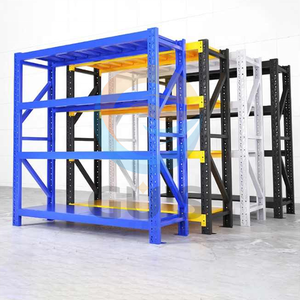
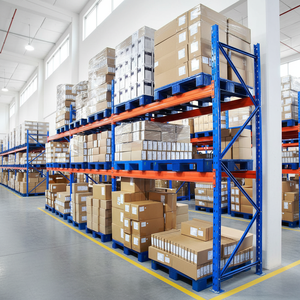
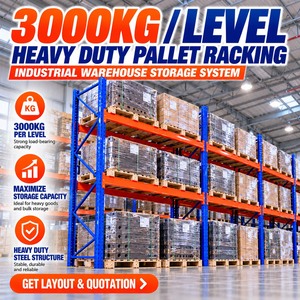
Selective pallet racking remains the universal benchmark for fast-moving consumer goods (FMCG) and third-party logistics (3PL) providers. Offering 100% immediate pallet accessibility, selective racking allows warehouse managers to store up to $3,000\text{ kg}$ per level using custom-formed teardrop, diamond, or 75mm/76.2mm pitch beam connectors. Frame heights reach up to 15 meters, integrated with safety drop-locks that prevent accidental beam displacement from forklift tines.
B. Heavy-Duty & Light-Duty Cantilever Racking with Pivot Arm Technology
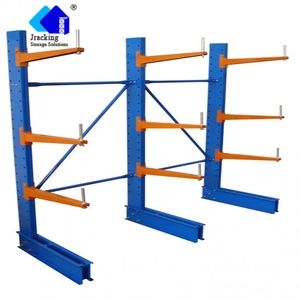
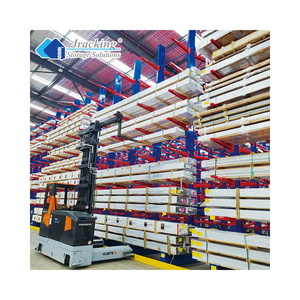
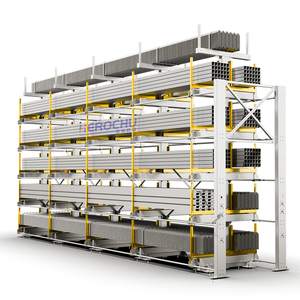
For non-standard, long-format inventory such as extruded aluminum profiles, structural steel pipes, timber packs, and PVC tubing, standard front-upright racks are unsuitable. Our industrial 5-layer and heavy-duty long arm cantilever racking systems remove front columns entirely, creating an unobstructed lateral storage plane.
Incorporating Pivot Arm Technology, cantilever arms are pinned securely to vertical columns rather than rigidly bolted. When struck by a misaligned forklift or crane load, the arm swivels upward and outward without bending or transmitting destructive torque directly into the main upright column. This reduces structural damage and maintenance costs by over 75%.
C. Modular Stacking Post Racks & Boltless Shelving Units
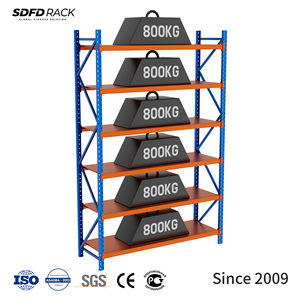
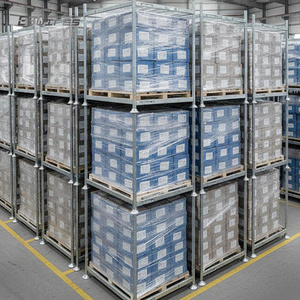
Flexible manufacturing environments require adaptable floor space. Q235 steel detachable stacking post pallet racks provide portable, stackable storage blocks capable of stacking 4 to 6 units high when loaded. When idle, post racks break down quickly to reclaim over 80% of floor space. For lighter manual picking operations, boltless stackable shelving units feature keyhole slot connections, allowing tool-free assembly, shelf height adjustment every 38mm, and single-shelf load capabilities ranging from 150kg to 800kg.
3. Global Procurement Technical Matrix
Use this engineering comparison matrix to match warehouse operational KPIs with appropriate structural racking configurations exported from China manufacturing centers:
| Racking Architecture | Space Utilization | Pallet Selectivity | Max Load per Level | Ideal Industry Application |
|---|---|---|---|---|
| Selective Pallet Racks | 40% - 50% | 100% (Direct Access) | Up to 4,500 kg | 3PL Logistics, Retail Distribution, FMCG |
| Radio Shuttle Racking | 75% - 85% | LIFO / FIFO (Selective) | Up to 1,500 kg/pallet | Cold Storage, Food & Beverage, High Density |
| Cantilever Systems | 55% - 65% | 100% (Linear Axis) | 3,000 kg / Arm | Timber Yards, Steel Tubing, Building Supplies |
| Drive-In / Drive-Thru | 65% - 75% | LIFO / FIFO Batch | Up to 1,500 kg/pallet | Seasonal Agricultural Exports, Cold Chain |
| Stacking Post Racks | 60% (Dynamic) | Block Stacked | 1,500 kg / Unit | Textile Rolls, Automotive Staging, Seasonal |
| Mezzanine Platforms | 100% (Vertical Expansion) | 100% Deck Access | 300 - 1,000 kg / m² | E-commerce Picking, Spare Parts, Hardware |
4. Future Procurement Trends & Sourcing Intelligence
As global logistics ecosystems accelerate toward complete digital transformation, procurement officers and engineering directors must evaluate prospective Chinese racking exporters beyond unit price per kilogram. Key trends reshaping international rack procurement include:
A. Automation-Ready Infrastructure Tolerance
Traditional manual warehouse racking allows millimeter-scale fabrication variances without operational disruption. However, integration with Automated Guided Vehicles (AGVs), Autonomous Mobile Robots (AMRs), and AS/RS stacker cranes requires ultra-strict fabrication tolerances ($\le \pm 0.5\text{ mm}$). Future-proof racking lines manufactured in China utilize automated robotic welding cells, continuous cold roll-forming lines, and laser-guided punching machines. This guarantees precise hole pitch alignment across 20-meter upright spans, enabling seamless integration of automated shuttles and sensor-guided material handling equipment.
B. Shipping Optimization & Total Cost of Ownership (TCO)
Global ocean freight dynamics make volumetric packaging efficiency vital to TCO management. Leading exporters utilize custom nesting software to pack upright frames, box beams, and wire mesh decks tightly into 40ft High Cube (40HC) containers. Disassembled frame designs (knocked-down structures) reduce shipping volume by up to 65% compared to fully welded uprights, ensuring maximum container weight capacity ($26\text{--}28\text{ metric tons}$) is achieved while reducing freight charges per pallet position.
C. Green Steel Metallurgy & Sustainable Manufacturing
Scope 3 carbon emissions auditing is rapidly becoming mandatory for tier-1 enterprises in North America and Europe. Premier Chinese manufacturing centers are transitioning to electric arc furnace (EAF) steel processing and closed-loop solar-powered powder coating plants. Procuring racking engineered from recyclable Q235/Q355 steel with low carbon intensity certifications provides buyers with a distinct ESG advantage in corporate sustainability reporting.
5. Industry Development: Smart Racking & Structural IoT Integration
The industrial racking sector is undergoing a paradigm shift from passive static steel arrays to active, sensor-enabled structural assets. Modern high-bay installations are increasingly equipped with embedded IoT sensors and strain gauges:
- Real-Time Deflection Sensors: Optical laser telemetry measure horizontal beam deflection under dynamic live loads, alerting floor managers immediately if safe working limits ($L/200$) are exceeded.
- Forklift Impact Detection Modules: Wireless tri-axial accelerometers mounted on corner upright protectors record collision energy and send automated maintenance tickets when structural impacts breach pre-set safety thresholds.
- Seismic Vibration Early-Warning Integrations: Smart baseplate sensors interface with facility building management systems (BMS) to freeze automated crane operations instantly upon sensing initial P-wave seismic oscillations.
Furthermore, cold chain logisticians are expanding sub-zero automated shuttle installations. Steel formulations enriched with trace manganese and titanium components prevent low-temperature steel embrittlement, allowing racking components to maintain impact resistance down to $-30^\circ\text{C}$ without micro-cracking or structural degradation over multi-year cycles.
6. Why Partner with China’s Leading Racking Exporters & Engineering Specialists
Our enterprise infrastructure seamlessly unites world-class structural manufacturing with end-to-end engineering support. We deliver turn-key warehouse solutions engineered for global compliance, long-term safety, and maximum space ROI.
Site-Specific Structural Engineering
Every layout undergoes rigorous static and dynamic FEA stress analysis, slab load verification, and localized seismic hazard alignment (ANSI MH16.1 / EN 15512).
Coastal-Grade Finishing Systems
Hot-dip galvanizing and multi-stage epoxy-polyester powder coatings protect steel profiles against marine salt air, severe industrial humidity, and chemical abrasion.
Turn-Key Lifecycle Execution
From preliminary CAD space planning and container loading optimization to certified field installation support, safety inspections, and system expansion.
7. Frequently Asked Questions (FAQ) for International Buyers
Accelerate Your Warehouse Capacity with Certified Engineering
Connect directly with our senior structural engineering team. Receive custom 2D/3D CAD layouts, localized seismic calculations, and factory-direct pricing within 24 hours.
Send an Inquiry