
Commercial Heavy Duty Boltless Steel Shelving System Warehouse Industrial Storage Rack Pallet Racking Unit
- Grade: High Tensile Q235B Steel
- Pitch: 50mm / 75mm Adjustable
- Lock: 3/4-Hook Connector Pin
Engineered for intense load distribution, high vertical clearance accuracy, and seamless integration with standard teardrop, step, and box beam structural configurations.
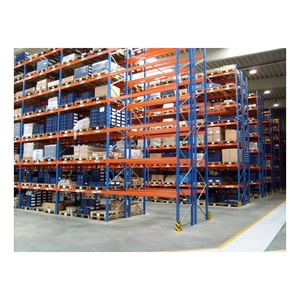
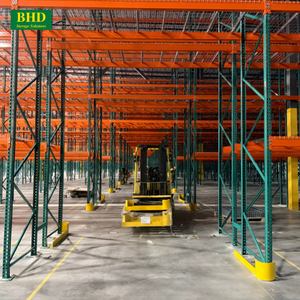
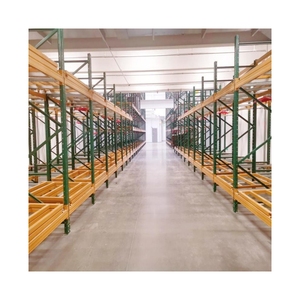
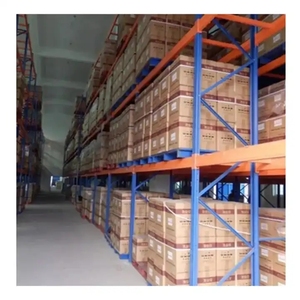
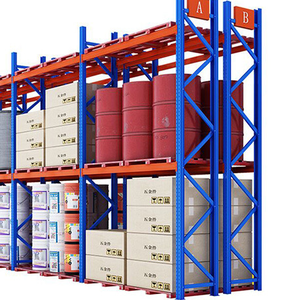
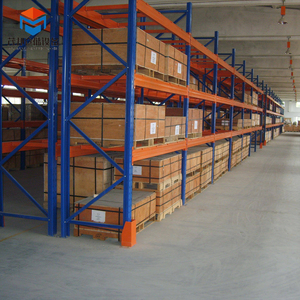
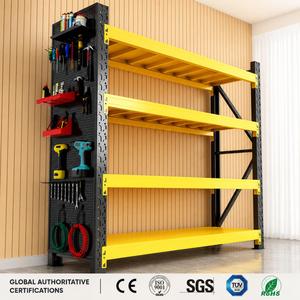
In high-density industrial storage, warehouse racking beams serve as the primary horizontal load-bearing members that transfer dead loads (system self-weight) and live loads (stored unit pallets) directly to vertical upright frames. The structural efficiency of a pallet racking installation depends almost entirely on the cross-sectional geometry, moment of inertia ($I$), and yield strength ($f_y$) of the beam profiles utilized. China’s manufacturing ecosystem for warehouse racking has evolved from basic cold-formed channels to highly optimized, computer-modeled roll-formed box beams and step beams that comply with stringent global engineering frameworks including ANSI MH16.1, EN 15512, and FEM 10.2.02.
Industrial racking beams manufactured in China primarily fall into two structural categories: cold-rolled box beams (interlocking twin-C channels) and hot-rolled structural C-channel beams. Understanding the mechanical trade-offs between these two profiles is crucial for procurement directors and logistics engineers:
A primary failure mode in under-engineered racking systems is excessive vertical deflection. According to FEM 10.2.02 and RMI (Rack Manufacturers Institute) standards, maximum allowable beam deflection under full design load must not exceed $L/200$, where $L$ represents the clear span of the beam between upright frames. For a standard 2700mm (8.86 ft) beam span carrying two 1,000kg pallets, the maximum vertical deflection at mid-span must remain strictly under 13.5mm.
Exceeding $L/200$ creates horizontal forces that push out frame columns, destabilizes pallet positioning, increases the risk of beam connector disengagement, and accelerates material fatigue. Advanced Chinese manufacturers utilize finite element analysis (FEA) software to simulate maximum flexural stress points ($\sigma_{max} = M / Z$) and optimize internal stiffness ribs along the beam profile, ensuring load stability under dynamic forklift placement.
The structural junction where the racking beam attaches to the vertical column upright represents a critical stress concentration zone. Modern high-capacity racking beams feature multi-hook welded end connectors (claws or drop-hooks) engineered with precise pitch geometry (typically 50mm, 75mm, or 76.2mm / 3-inch teardrop spacing):
Evaluate beam profiles based on structural geometry, load distribution capabilities, accessory compatibility, and target industry deployment.
| Beam Profile Type | Section Geometry | Typical Load Capacity | Deflection Limit | Primary Decking Compatibility | Target Application |
|---|---|---|---|---|---|
| Nested Box Beam | Dual C-Channel Seam Welded | 1,000 kg – 4,500 kg / pair | $L/200$ (FEM 10.2.02) | Pallet Supports, Flat Decks | High-Bay Logistics, Selective Racking |
| 1-5/8" Step Beam | Stepped Top Edge Profile | 800 kg – 3,500 kg / pair | $L/180$ to $L/200$ | Wire Mesh Decking, Drop-in Panels | US Teardrop Racking, FMCG Warehousing |
| Structural C-Channel | Hot-Rolled Structural Steel | 3,000 kg – 6,000+ kg / pair | $L/240$ (High Stiffness) | Heavy Steel Grating, Timber Bar | Heavy Machinery, Raw Metal Storage |
| P-Type Step Beam | Lip Profile for Light Shelving | 200 kg – 800 kg / level | $L/150$ | Steel Shelves, MDF Board | Medium-Duty Picking, Archive Storage |
| Push-Back Guide Beam | Reinforced Rail Profile | 1,500 kg – 4,000 kg / lane | $L/220$ | Nested Wheel Carts / Flow Rails | High-Density LIFO Bulk Cold Storage |
Key structural shifts, economic drivers, and supply chain strategies transforming high-volume procurement of warehouse steel infrastructure.
Global logistics operators are combining direct Chinese manufacturing (benefiting from scale, advanced steel production, and raw material access) with secondary regional hubs. Procurement leaders utilize standardized beam connection profiles across global facilities to ensure modularity, enabling quick hardware swapping between Asian, European, and American distribution networks.
Fluctuations in hot-rolled coil (HRC) steel prices directly impact procurement costs. Leading B2B buyers now structure multi-year supply contracts using transparent steel index formulas tied to the Shanghai Steel Exchange, combining material cost transparency with fixed roll-forming processing fees for large-scale rack rollouts.
The rapid growth of frozen food and pharmaceutical logistics is driving demand for specialized racking beam finishes. Procurement is shifting away from standard indoor powder coatings toward hot-dip galvanizing (HDG) compliant with ISO 1461, preventing micro-fissure corrosion caused by continuous condensation, thermal cycling (-30°C to +4°C), and chemical washdowns.
The global industrial storage landscape is shifting toward higher vertical storage densities, integration with Automated Storage and Retrieval Systems (AS/RS), and real-time structural health monitoring. China’s leading racking manufacturers are heavily investing in R&D to push the boundaries of structural beam capabilities.
As automated guided vehicles (AGVs) and high-speed cranes operate at speeds up to 4 m/s inside AS/RS high-bay structures, localized beam impacts and overloading pose operational risks. Next-generation structural beams are being developed with embedded strain gauges, micro-piezoelectric sensors, and optical fiber Bragg grating (FBG) arrays along the beam web:
Traditional racking beams rely on standard carbon structural steel (Q235B or Q355B). Advances in roll-forming technology allow the processing of next-generation TMCP high-strength micro-alloyed steels (such as Q460 or Q550 grade). These advanced alloys allow manufacturers to reduce beam wall thickness by 15% to 22% while maintaining identical ultimate tensile strength and moment of inertia. This reduction lowers deadweight on base plates, decreases shipping container transport costs, and reduces the carbon footprint of structural warehouse installations.
Conventional box beams rely on CO2 gas shielded semi-automatic welding, which can leave minor weld spatter or slight seam variations. Leading Chinese export manufacturers are replacing manual weld stations with fully integrated 3D fiber laser continuous welding lines. Laser welding achieves deep weld penetration with minimal heat-affected zones (HAZ), reducing internal residual stresses along the box beam junction and extending fatigue life under heavy dynamic loading cycles.
To combat surface scratching from metal pallet runners, high-durability powder coating formulations now incorporate micro-encapsulated self-healing polymers and ceramic nano-particles. When a forklift fork scratches the coating surface, pressure-activated micro-capsules rupture, releasing anti-corrosive sealing compounds that prevent sub-surface rust migration in humid environments.
Leveraging advanced steel processing infrastructure, certified structural calculations, and rigorous quality control for reliable global distribution.
Every racking system layout undergoes site-specific seismic hazard modeling compliant with local standards (e.g., US ASCE 7, Latin American NEC-SE-DS, European Eurocode 8). Beam end connections and floor anchor base plates are verified against combined shear and overturning moments.
For high-humidity port facilities (such as Guayaquil, Manta, or Houston), components are treated with high-durability pre-galvanization, hot-dip galvanizing (ISO 1461), or thermo-cured epoxy-polyester electrostatic coatings resistant to 500+ hours of salt spray testing (ASTM B117).
From prime cold-rolled coil slitting and automated continuous roll-forming to robotic claw welding and automated powder coating lines, every production step is controlled under ISO 9001 certified quality management protocols.
Comprehensive project lifecycle management includes initial CAD layout drafting, structural calculation validation, export-grade bundle packaging, international shipping logistics, installation supervision, and post-installation safety inspection certification.
Essential technical and commercial guidance for warehouse managers, structural engineers, and procurement directors sourcing racking systems from China.
China-manufactured warehouse racking beams primarily use high-grade structural carbon steels Q235B and Q355B (formerly Q345B). Q235B yields a minimum strength of 235 MPa, equivalent to ASTM A36 or European S235JR, making it ideal for standard pallet loads up to 2,000 kg per beam level. For higher capacity requirements (3,000 kg to 5,000 kg/pair) or high-bay AS/RS systems, manufacturers utilize Q355B steel, offering a minimum yield strength of 355 MPa—equivalent to ASTM A572 Grade 50 or European S355JR. Using higher-yield Q355B allows thinner wall profiles while maintaining structural integrity, reducing shipping weight and total material costs.
Beam deflection is calculated using classical beam bending formulas derived from structural mechanics: $\delta = \frac{5 \cdot w \cdot L^4}{384 \cdot E \cdot I}$ for uniformly distributed loads, where $w$ is the load per unit length, $L$ is clear span, $E$ is Young’s modulus of steel ($2.1 \times 10^5 \text{ N/mm}^2$), and $I$ is moment of inertia. International standards (ANSI MH16.1, FEM 10.2.02) mandate that maximum deflection under full rated load must not exceed $L/200$. Exceeding this limit causes plastic deformation, induces high lateral bending forces on vertical upright frames, damages automatic locking pins, and increases the risk of pallet dislodgement during forklift placement.
For standard dry indoor warehouses (15°C to 30°C, low humidity), high-durability electrostatic epoxy-polyester powder coating (60–80 microns thick) provides excellent scratch resistance and visual aisle color-coding. However, for coastal warehouses exposed to salt-laden air (such as port facilities in Guayaquil, Manta, or Southeast Asia) or cold-storage facilities experiencing condensation cycles (-30°C to +4°C), Hot-Dip Galvanizing (HDG) per ISO 1461 or pre-galvanized coil profiling is recommended. HDG applies a metallurgical zinc coating (55–85 microns) that acts as a sacrificial anode, preventing rust even if the metal surface is scratched during daily material handling.
Yes. Chinese manufacturers produce fully interchangeable US-standard Teardrop pallet racking beams. These feature standard 2-inch (50.8mm) hole pitch centers, 1-5/8 inch step depths, and specialized teardrop claw connectors compatible with major North American frame manufacturers. All designs undergo physical testing compliant with RMI (Rack Manufacturers Institute) and ANSI MH16.1 standards, ensuring full mechanical compatibility, load rating parity, and safety pin alignment when integrated into existing distribution centers.
To generate a precise structural calculation and CAD drawing, engineering teams require: (1) Building architectural CAD files showing clear height under sprinklers/trusses, column grid layouts, slab thickness, and door locations; (2) Pallet specifications—width, depth, overall height including cargo, and maximum weight per pallet; (3) Material handling equipment specs—forklift make/model, turning radius, and maximum lift height; (4) Inventory operational metrics—number of SKUs, required selectivity (FIFO vs. LIFO), and target pallet storage capacity; and (5) Project location to evaluate local seismic hazard factors and floor concrete strength ($f'c$).
Beam export bundling uses heavy-duty steel strapping and protective packaging materials. Beams are stacked in interlocking pairs, separated by corrugated plastic or wooden dunnage strips to prevent paint-to-paint abrasion. Bundle corners are protected with heavy-duty cardboard edge guards, and the entire assembly is wrapped in waterproof plastic film. Heavy steel base runners are integrated into each bundle, allowing forklift loading and unloading from 40-foot High Cube (40HC) ocean containers without damaging connector hooks or powder-coated surfaces.
Connect directly with senior structural engineering teams to receive CAD layout designs, structural seismic calculations, factory-direct pricing, and comprehensive product catalogs.