Heavy Duty Storage Systems Product Catalog
Explore our wholesale enterprise pallet racking and industrial shelving line, engineered directly by Chinese manufacturing experts.
Structural Analysis & Mechanics of Push Back Pallet Racking
A comprehensive examination of dynamic Last-In, First-Out (LIFO) pallet storage engineering, nesting cart dynamics, slope inclination physics, and factory procurement strategies from leading Chinese manufacturers.
Kinematic Nesting Cart Mechanics
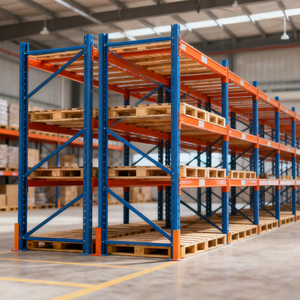
Push Back pallet racking utilizes a series of nested, structural steel carts resting on inclined steel rails mounted to structural upright frames. Under standard operations, the first pallet is placed on the top cart by a standard forklift. When the second pallet is loaded, the forklift operator gently pushes the first pallet back along the inclined rail track (typically set at a precise 1.5° to 2.0° pitch slope), revealing the second nested cart. This process repeats for up to 2-deep, 3-deep, 4-deep, 5-deep, or 6-deep configurations.
When unloading, gravity smoothly moves the remaining pallets forward to the aisle front face at a controlled speed, eliminated through integrated safety speed controllers, heavy-duty flange wheels, and mechanical stops.
Structural Steel Integrity & Seismic Design
Chinese manufacturing standards (GB/T 13793 / Q235B & Q355B high-tensile structural cold-rolled steel) are engineered to withstand extreme dynamic kinetic loads during pushing and gravity descent. For facilities in high seismic zones, our rack layouts comply with international codes such as ANSI MH16.1, EN 16681, and regional structural mandates (such as NEC-SE-DS seismic hazard parameters).
Baseplate thickness, footplate anchor bolts (M12 to M16 chemical or expansion anchors), and frame bracing geometries are custom calculated according to the site's concrete slab thickness, soil acceleration index, and maximum operational load profile.
High-Density Storage System Architecture Matrix
Compare Push Back Pallet Racking against alternative industrial storage systems to optimize SKU density, operational velocity, and total cost of ownership (TCO).
| Racking Architecture Type | Storage Density | SKU Selectivity | Stock Rotation Method | Forklift Aisle Space Required | Typical Application Fit |
|---|---|---|---|---|---|
| Push Back Pallet Racking |
|
|
LIFO (Last-In, First-Out) | Standard (3.2m - 3.8m) | Medium SKU counts, cold storage, FMCG staging, high throughput |
| Selective Pallet Racking |
|
|
100% Direct Access | Standard to VNA (1.8m - 3.5m) | High SKU variety, lower density, fast picking, general logistics |
| Drive-In / Drive-Thru Rack |
|
|
LIFO / FIFO | Internal Drive Lanes | Low SKU variety, seasonal bulk goods, low rotation velocity |
| Pallet Flow Gravity Racking |
|
|
Strict FIFO (First-In, First-Out) | Separate Loading & Unloading Aisles | Perishable food, pharmaceuticals, expiration date batch management |
| Radio Shuttle Automation |
|
|
Automated LIFO / FIFO | Single/Dual Handling Aisle | Automated distribution hubs, high upfront cap-ex, deep lane storage |
65,000+
Tons Annual Steel Output
85+
Export Countries & Regions
100%
Ultrasonic Weld Inspected
15-Year
Structural Frame Warranty
Why Partner with Direct Chinese Wholesale Manufacturers?
From raw coil processing to automated robotic welding and specialized surface treatments, discover the structural engineering superiority of factory-direct supply chains.
Automated Cold-Roll Forming
Our factory operates 24 continuous cold-roll forming lines with real-time laser measurement gauge calibration. Upright profiles feature complex multi-rib cross-sections engineered to increase torsional rigidity by 35% compared to standard open C-channels.
Robotic CO2 Shielded Welding
Cart frames, track support brackets, and beam connectors are welded using automated Panasonic robotic arms. Full weld penetration eliminates stress concentrations, ensuring cart alignment stays rigid under heavy repetitive forklift loading.
Coastal & Cold Room Finishes
We offer dual corrosion protection treatments: 22-stage automatic phosphating followed by electrostatic epoxy-polyester powder coating (60-80 microns thickness) or full Hot-Dip Galvanizing (HDG) per ISO 1461 for high-humidity coastal ports (e.g. Guayaquil, Manta) and freezer storage (-30°C).
Future Development Trends in Push Back Racking Technology
Anticipate industrial supply chain shifts, warehouse automation integration, and material engineering advancements when planning capital storage investments.
1. AMR Staging & Dynamic Push-Back Integration
Modern distribution centers are moving beyond manual forklift operation towards hybrid automation. Future push-back rack systems are being designed with low-profile cart entry thresholds optimized for Autonomous Mobile Robots (AMRs) and Automated Guided Vehicles (AGVs). Embedded optical sensors on front push-back beams communicate directly with Warehouse Execution Software (WES) to track pallet occupancy and gravity descent speed in real-time.
2. Low-Temperature Synthetic Bearing Metallurgy
Cold chain operations in pharmaceutical and frozen food logistics demand uninterrupted cart motion without lubricant freezing. Chinese steel mills and OEM factories are deploying self-lubricating polymer-encapsulated stainless steel bearings rated for continuous operation down to -35°C. This eliminates maintenance friction points and prevents pallet jamming caused by frost buildup along the inclined track.
3. Ultra-High Tensile Light-Gauge Steel Profiles
Sustainability and carbon footprint reduction are reshaping rack design. By utilizing advanced micro-alloyed structural steels (e.g. Q355B and Q460 structural grades), engineers can reduce total steel weight by 12-15% while maintaining identical structural load ratings (1,000kg to 1,500kg per pallet). This yields significant freight savings per container shipment for international buyers.
4. Modular Nesting Kits for Rapid Overseas Deployment
To streamline field installation overseas, factory manufacturers are standardizing modular push-back rail packages. Pre-assembled cart-in-cart modules reduce job site labor hours by up to 40%. Buyers receive factory-calibrated rail slope units that bolt directly into standard pallet rack step beams with simple hand tools and precision alignment fixtures.
Frequently Asked Questions (FAQ) for Global Buyers
Essential technical, operational, and commercial insights for engineers, warehouse operational directors, and wholesale importers.
How does Push Back Racking compare to Drive-In Racking in terms of operational efficiency?
While both are high-density LIFO systems, Push Back racking eliminates the requirement for forklifts to drive inside the racking structure. This significantly reduces rack column damage, improves pallet loading cycle times by 30-50%, and allows each lane to hold a different SKU, offering drastically superior SKU selectivity compared to Drive-In racks.
What floor slab specifications and tilt tolerances are required?
Push Back racking requires a level, reinforced concrete slab engineered to handle point load reactions from frame baseplates (typically 30kN to 90kN per post depending on height). Floor flatness should conform to Superflat or FF35/FL25 standards. Shims are used during installation to ensure rail incline remains perfectly uniform at 1.5° to 2°.
Can standard forklifts be used with Push Back Pallet Systems?
Yes. Standard counterbalance forklifts and reach trucks are fully compatible. The forklift must have sufficient pushing power to overcome the gravity slope when loading nested carts. No specialized attachments are necessary, though tilt-indicators on the forklift mast are recommended for high-bay operations.
What customized pallet sizes and load weights can be accommodated?
Custom engineering is standard. We design carts for GMA (48"x40"), EURO (1200x800mm), Industrial (1200x1000mm), and non-standard plastic or wooden pallets. Dynamic load capacity ranges from 500kg up to 1,500kg (3,300 lbs) per cart position, with custom cart nesting up to 6-deep.
How are international shipments packaged to prevent transit damage?
Racking components are bundled with steel strapping, wrapped in protective foam sheets, and fitted with plastic corner guards. Nested cart modules are cradled in wooden crating to protect precision bearings and track wheels during container ocean freight.
What is the typical lead time from design approval to container dispatch?
Standard engineering CAD drawings are delivered in 48 hours. Upon design lock and deposit, manufacturing lead time is generally 20 to 30 days for 2-5 high-cube (40HQ) containers, supported by comprehensive installation manuals and remote engineering sign-off.
Quality Assurance & ISO Certification
Every production batch undergoes rigorous destructive and non-destructive structural testing. Steel coils are verified via mill test certificates (MTC) for chemical composition and yield strength (Q235B ≥ 235 MPa, Q355B ≥ 355 MPa). Samples undergo salt spray testing (ASTM B117) exceeding 500 hours without red rust, guaranteeing long-term durability in tropical and coastal marine climates.
Global OEM Turnkey Engineering Support
Our dedicated engineering team partners with global logistics managers, third-party logistics (3PL) providers, and industrial distributors. We supply full structural calculations, AutoCad 2D layouts, 3D BIM models, and stamped engineering documentation tailored to local structural building codes across North America, South America, Europe, the Middle East, and Southeast Asia.
Request Custom Engineering Layout & Wholesale Factory Pricing
Send us your warehouse dimensions, pallet specs, clear ceiling height, and target storage position goals. Our senior rack engineers will deliver a free structural CAD layout and comprehensive factory direct quotation within 24 hours.