Direct-from-Factory Industrial Pallet Racking Systems
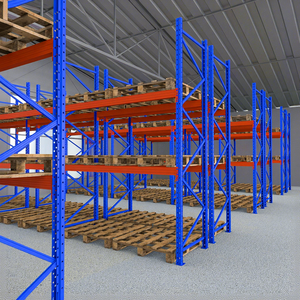
As a certified original manufacturer and global B2B wholesaler, we deliver CE, ISO 9001, and FEM 10.2.02 compliant pallet racking engineered from high-tensile Q235B and Q355B cold-rolled steel. Our high-bay solutions optimize warehouse cubic space, minimize total cost of ownership (TCO), and withstand rigorous seismic and dynamic load demands.
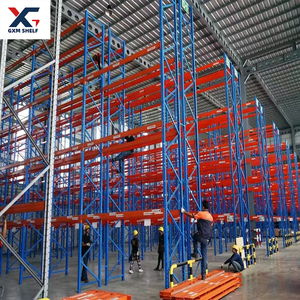
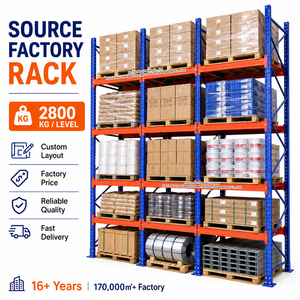
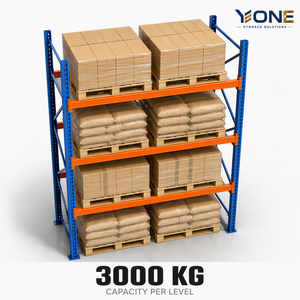
Factory Advantages & Manufacturing Excellence
Why tier-1 global logistics hubs, cold-storage facilities, and FMCG enterprise buyers partner with our engineering factory.
Rigorous Structural Certifications
Full international compliance with CE European Conformity, EN 15512, FEM 10.2.02, ANSI MH16.1, and ISO 9001:2015. Every rack structural profile undergoes rigorous Finite Element Analysis (FEA) to verify yield strength and stability limits under full design payloads.
High-Grade Cold-Rolled Metallurgical Steel
We source prime, traceable Q235B and Q355B cold-rolled steel coils directly from top-tier steel mills. Our structural cold-formed profiles provide exceptional yield strength ($f_y \ge 355 \text{ MPa}$) and high ductility, ensuring fatigue resistance across long operational cycles.
Automated Finishing & Anti-Corrosion Treatment
Features automated multi-stage pre-wash, phosphating, and electro-static epoxy-polyester powder coating (60–80 µm thickness). Our finishes survive 500+ hours of continuous neutral salt-spray exposure, ideal for humid coastal and cold-chain facilities.
Seismic & Environmental Engineering
Configured specifically for region-specific ground conditions and seismic hazard criteria. Base plates, heavy-duty floor expansion anchors, and column upright bracing patterns are mathematically verified to prevent sway during ground motion events.
Bespoke Intralogistics Customization
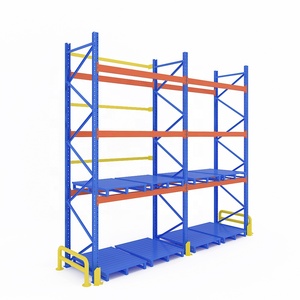
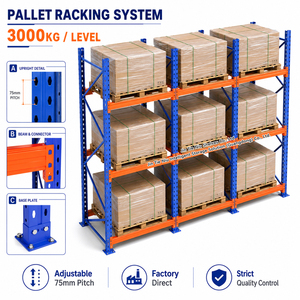
Every industrial warehouse space exhibits unique constraints. We deliver custom beam profiles (box beams, step beams), upright column depths (up to 12+ meters high), adjustable beam pitch pitch slots (50mm/75mm), and safety back-stoppers tailored to your specific MHE.
Direct OEM Wholesale Factory Pricing
Eliminate middleman markups. Direct purchasing from our automated factory guarantees factory-direct pricing, guaranteed steel quality certificates, standardized raw material traceability, and dedicated project engineering management from blueprint to delivery.
Engineering Deep-Dive: Material Mechanics, Structural Design, and Safety Margins
In modern industrial warehousing, selecting a heavy-duty pallet racking system requires detailed consideration of dynamic material handling, static structural mechanics, and safety factors. Rack structures are slender steel frames subjected to high axial compression and lateral loads. Structural integrity depends on cold-formed steel section design, beam-to-column connector rigidity, dynamic loading, and sway bracing.
1. Cold-Formed Steel Metallurgy & Column Profile Geometry
Our industrial racking frames utilize high-grade, cold-rolled structural steel profiles (Q235B and Q355B). The cold-forming process increases yield strength via strain hardening while maintaining elastic elongation. Column uprights feature multi-ribbed geometrical profiles (such as 80mm×60mm, 90mm×65mm, 100mm×68mm, and 120mm×75mm profiles) with teardrop or diamond punching patterns.
- Structural Yield Stress ($f_y$): Minimum 235 MPa for Q235B; minimum 355 MPa for Q355B structural steel.
- Sectional Inertia ($I_x, I_y$): Optimized multi-flange fold geometries increase torsional stiffness and flexural-torsional buckling resistance under high axial forces.
- Safety Factor ($\gamma_M$): Engineered with a standard safety factor of 1.55 to 1.65 above nominal safe working load limits, complying with EN 15512 structural design formulas.
2. Beam Deflection Mechanics & Connector Joint Rigidity
Horizontal rack beams (box beams or step beams) support heavy pallet loads directly. Structural limits are dictated by vertical deflection criteria under total uniform load ($W$). In accordance with FEM 10.2.02 standards, maximum beam deflection ($\delta$) must not exceed:
Deflection Limit: $\delta \le \frac{L}{200}$ or $\delta \le \frac{L}{300}$ (where $L$ is clear span length between upright columns).
Each beam connector uses welded, multi-hook steel claws (3 to 5 claw hooks) with automatic safety locking pins. This creates a semi-rigid joint that transfers bending moments into the uprights while preventing accidental dislodgement from upward forklift impacts.
3. Surface Protection Chemistry & Anti-Corrosion Longevity
Warehouse storage systems face varying environmental factors—ranging from temperature-controlled e-commerce hubs to cold-chain sub-zero freezers ($-30^\circ\text{C}$) and humid coastal marine atmospheres. Our surface protection involves:
- Automatic Multi-Stage Degreasing & Pre-treatment: Alkaline wash, iron-phosphate film application, and deionized water rinsing to ensure pure substrate bonding.
- Electrostatic Powder Application: Thermosetting epoxy-polyester powder applied electrostatically at 60–80 kilovolts.
- Thermal Curing: Cured in automated industrial baking tunnels at $180^\circ\text{C} - 200^\circ\text{C}$, forming an impact-resistant, chemical-proof coating with a thickness of $60 \mu\text{m} - 80 \mu\text{m}$.
Industrial Pallet Racking Selection Framework
Compare high-density, selective, and automated racking configurations to select the ideal storage architecture for your operational throughput and SKU profile.
| Racking System Type | Storage Density | Pallet Selectivity | Stock Management | Load Capacity / Tier | Primary Application |
|---|---|---|---|---|---|
| Selective Pallet Racking | Medium (40-50%) | 100% Direct Access | FIFO (First-In, First-Out) | 1000 kg – 4500 kg | High SKU counts, general warehousing, fast distribution |
| Double-Deep Racking | High (60-65%) | 50% Immediate Access | FILO / LIFO | 1000 kg – 3000 kg | Identical SKUs, medium rotation, pantograph forklifts |
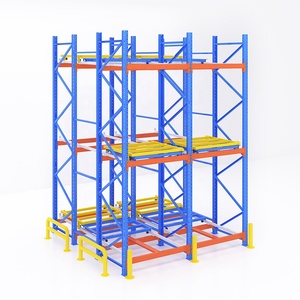
| Drive-In / Drive-Thru | Very High (75-85%) | Low Selectivity | LIFO (Drive-In) / FIFO | 1000 kg – 2000 kg | Cold storage, bulk seasonal goods, homogenous items |
| Push-Back Racking | High (65-75%) | Medium Selectivity | LIFO (Cart / Roller) | 1000 kg – 2500 kg | Medium-density staging, 2-6 pallet deep lanes |
| Pallet Live Flow Racking | Very High (80-90%) | High per Lane | Strict FIFO | 500 kg – 1800 kg | Perishable food, pharmaceuticals, high-throughput buffers |
| Radio Shuttle Automation | Ultra High (85-92%) | Software Controlled | FIFO / LIFO Automated | 1000 kg – 2000 kg | Automated warehouses, smart logistics, labor-saving hubs |
Future Trends in Global Pallet Racking & Strategic Procurement (2025–2035)
The global industrial material handling landscape is undergoing a structural shift. Logistics leaders are moving away from treating storage rack buying purely as capital expenditure (CapEx) hardware purchasing. Instead, procurement strategies center on Total Cost of Ownership (TCO), intralogistics automation compatibility, and sustainable steel manufacturing.
1. Automated Guided Vehicle (AGV) & AMR Structural Synergy
As Autonomous Mobile Robots (AMRs) and automated forklifts replace conventional counterbalanced vehicles, structural rack manufacturing tolerances must tighten. Traditional manual operations accommodate slight column misalignments; automated guided equipment requires sub-millimeter precision. Future racking systems incorporate machine-readable barcode guide strips, integrated laser-positioning reflectors, and enlarged lead-in entry guides to prevent robotic impact damage.
2. IoT Structural Health Monitoring & Strain Sensing
Modern high-bay facilities (exceeding 12 to 18 meters in height) are adopting smart sensor integration. Fiber-optic strain sensors, micro-electromechanical systems (MEMS) accelerometers, and wireless load cells embedded into critical beam-column connections continuously transmit structural health metrics. These sensors detect permanent deformation, hidden forklift impact shocks, and localized overload conditions, enabling predictive maintenance before structural failures occur.
3. Green Steel & Low-Carbon Eco Coating Requirements
International ESG mandates are reshaping industrial procurement criteria across Europe, North America, and Australia. Industrial buyers evaluate suppliers based on Scope 1, 2, and 3 carbon emissions. Future-ready racking production prioritizes green steel manufactured via Electric Arc Furnaces (EAF) utilizing scrap metal and renewable energy, combined with solvent-free, zero-VOC powder coating formulations.
Frequently Asked Questions (Procurement & Engineering FAQ)
Essential answers for warehouse managers, industrial engineers, project managers, and global procurement officers.
Optimize Your Warehouse Cubic Capacity Today
Partner directly with a certified industrial manufacturer. Share your floor plan, load requirements, or project specifications, and our engineering team will provide a complimentary 3D CAD layout, structural load calculation, and factory wholesale quotation within 24 hours.
Get a Quote